Telecommunications Industry
Can Enterprise Fiber Optic Networking Keep Pace with Data-Hungry Applications?

Image Courtesy: Unsplash


Modern enterprises are processing more data than ever before. Artificial intelligence, cloud computing, real-time analytics, video collaboration, Internet of Things (IoT) devices, and edge applications continuously generate and exchange massive volumes of information. While these technologies create new business opportunities, they also place unprecedented demands on network infrastructure.
The question for many organizations is no longer whether bandwidth requirements will increase, but whether enterprise fiber optic networking can keep pace with data-hungry applications without compromising performance.
Also Read: How Can VoIP Internet Phone Systems Reduce the Hidden Costs of Missed Business Calls?
Why Are Enterprise Applications Consuming More Network Resources?
Today’s enterprise applications are fundamentally different from those of the past.
Business operations increasingly rely on AI-powered analytics, cloud-native platforms, high-resolution video conferencing, digital collaboration tools, and data-intensive workloads that require continuous, high-speed connectivity. Instead of transferring small files between local systems, organizations now move vast amounts of data across distributed environments in real time.
As these workloads expand, traditional network infrastructure may struggle to deliver the bandwidth, low latency, and reliability required for consistent performance.
How Does Enterprise Fiber Optic Networking Support High-Volume Data Traffic?
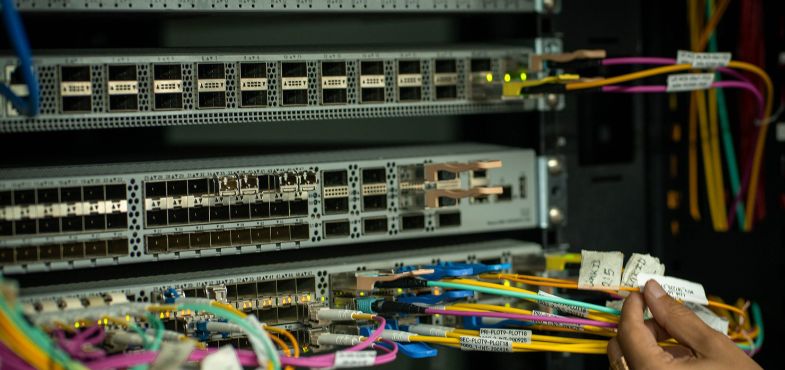
Unlike conventional networking technologies, enterprise fiber optic networking is designed to handle large-scale data transmission with minimal signal degradation over long distances.
Its high bandwidth capacity enables organizations to support simultaneous business-critical applications without creating network congestion. Whether employees are accessing cloud platforms, transferring large datasets, or running AI workloads, fiber infrastructure helps maintain consistent network performance under increasing demand.
This scalability allows businesses to accommodate future growth without repeatedly redesigning their core network architecture.
Why Is Low Latency Becoming More Important?
Network speed alone is no longer enough. Many modern applications depend on extremely fast response times.
Artificial intelligence, industrial automation, financial transactions, real-time monitoring, and unified communications all require information to move almost instantly between systems. Delays of even a few milliseconds can affect application performance and user experience.
Enterprise fiber optic networking supports these latency-sensitive environments by enabling faster data transmission and more predictable network performance, helping organizations maintain operational efficiency across distributed locations.
Can Enterprise Fiber Optic Networking Simplify Digital Transformation?
Digital transformation often involves integrating cloud services, hybrid work environments, connected devices, and data-driven business processes.
Each initiative introduces additional network complexity and higher data volumes. Without adequate infrastructure, organizations may experience bottlenecks that limit the success of digital initiatives.
Enterprise fiber optic networking provides a scalable foundation that supports these evolving requirements. Rather than becoming a constraint, the network becomes an enabler of innovation, allowing businesses to adopt emerging technologies with greater confidence.
How Does Fiber Infrastructure Prepare Organizations for Future Growth?
Technology adoption continues to accelerate, and future applications are likely to demand even greater bandwidth and network reliability.
As AI models become more sophisticated, connected devices increase, and data-intensive workloads expand, enterprise networks must be capable of supporting continuous growth.
Enterprise fiber optic networking offers the flexibility to scale alongside business requirements, reducing the need for frequent infrastructure replacements while supporting long-term digital strategies.
Also Read: Why Telecom Security Platforms Are Critical for Network Resilience
Conclusion
The rapid growth of AI, cloud computing, IoT, and real-time analytics is transforming enterprise networking requirements. Organizations need infrastructure that can deliver high bandwidth, low latency, and reliable performance as data volumes continue to increase.
Enterprise fiber optic networking provides the capacity and scalability required to support these data-hungry applications while enabling future technology adoption. Rather than simply meeting today’s connectivity demands, it helps organizations build a resilient digital foundation capable of supporting tomorrow’s business innovations.